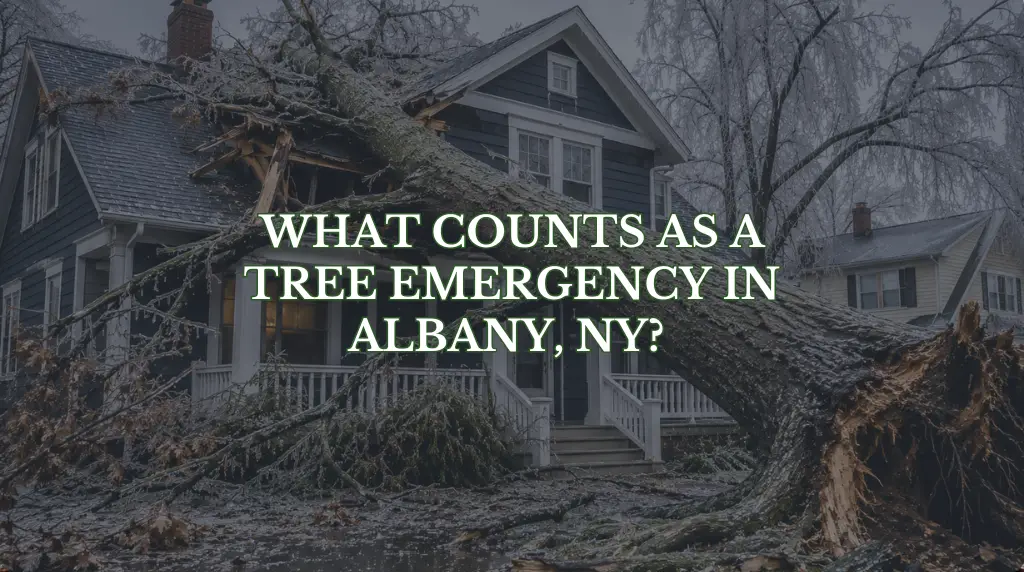
What Counts as a Tree Emergency in Albany, NY?
A tree emergency is any tree-related situation that poses an immediate risk to life, property, or essential utilities and cannot safely wait for a scheduled appointment.
In Albany, common emergencies include fallen trees on structures, branches touching power lines, storm-damaged leaning trees, and major structural failures after ice storms or severe weather.
Use the quick-reference table to identify your situation immediately:
| Situation | Emergency? | Response Time Needed |
|---|---|---|
| Tree on house, car, or structure | ✅ Yes | Within 1–2 hours |
| Branch resting on power line | ✅ Yes | Call utility first |
| Tree blocking road or driveway | ✅ Yes | Within 2–4 hours |
| Leaning tree after storm | ✅ Yes | Same day |
| Hanging broken branch | ✅ Yes | Same day |
| Split trunk or major crack | ✅ Yes | Within 24 hours |
| Dead tree near house | ⚠️ Urgent | Within 1 week |
| Minor branch breakage | ❌ No | Schedule normally |
| Cosmetic leaf damage | ❌ No | Schedule normally |
What Is a Tree Emergency?
A tree emergency is a tree-related hazard that requires arborist response within hours rather than scheduled days because it threatens human safety, structural property, or critical infrastructure.
The International Society of Arboriculture (ISA) classifies tree emergencies as situations where the probability of failure is “imminent” and the consequence of failure is “significant” meaning the tree is likely to fail soon, and when it does, it will cause real harm.
Three defining criteria identify a true tree emergency. Any one of these criteria qualifies the situation:
- Imminent risk of harm to people, pets, or occupants of nearby structures
- Active or imminent damage to a house, vehicle, fence, or utility line
- Public safety hazard blocking roads, sidewalks, driveways, or emergency egress
When any of these criteria is met, the situation cannot wait for a routine appointment. The response window is measured in hours.
9 Situations That Count as a Tree Emergency
Below are the nine tree emergency scenarios that Albany homeowners encounter most often, especially after Capital Region storms. Each situation requires immediate action — typically within the same day.
1. A Tree Has Fallen on Your House or Structure
A tree on a house is the most severe and most common tree emergency in Albany, NY, with hundreds of incidents each year following nor’easters and ice storms.
The fallen tree compromises the structural integrity of the roof, opens the building envelope to water damage, and can shift further with wind or settling.
For information on the full removal process after this happens, see our fallen tree removal service page.
What to do immediately:
- Evacuate the affected room and surrounding area
- Call 911 if anyone is injured or trapped
- Shut off electricity at the main breaker if the tree contacted any indoor wiring
- Document the damage with photos for insurance before any cleanup
- Call an emergency arborist for assessment and stabilization
2. A Branch or Tree Is Touching a Power Line
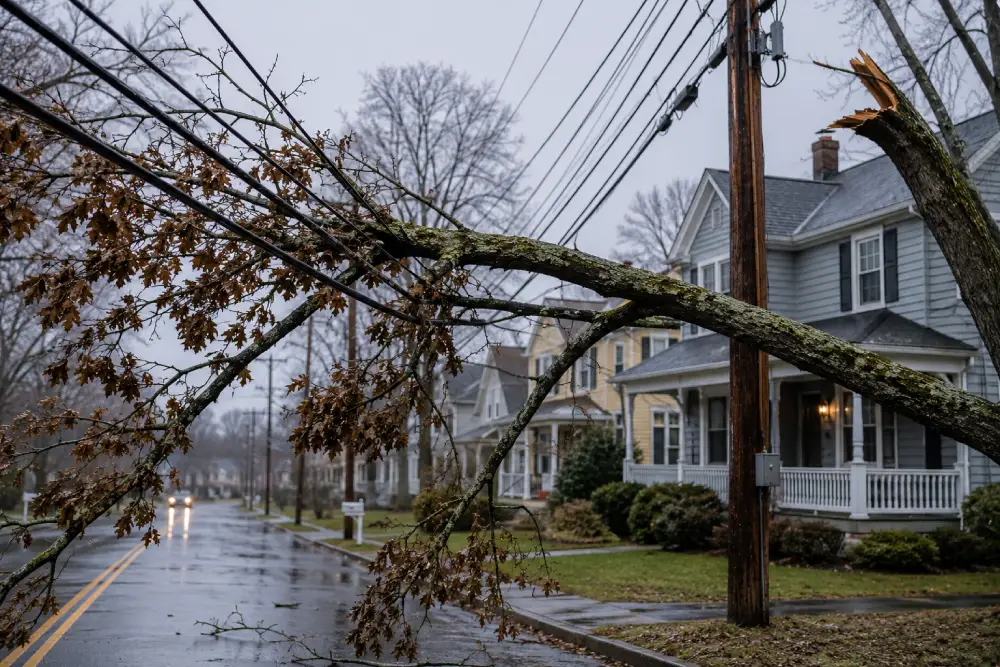
Tree contact with power lines is always a tree emergency, even when no sparks are visible, because the branch may be energized and conduct electricity to anyone who approaches.
Albany homeowners must call National Grid at 1-800-867-5222 first to de-energize the line before any tree work begins.
Never attempt to remove the branch yourself — utility contact accounts for roughly 16 chainsaw-related deaths annually across the United States, according to OSHA data.
3. A Tree Is Leaning at a New Angle After a Storm
A tree that has newly shifted angle is a structural failure in progress and requires same-day arborist response.
The lean indicates root failure on one side, partial trunk fracture, or both. Visible warning signs include exposed roots on the side opposite the lean, soil cracking around the trunk base, and mulch or turf that appears pushed upward.
A tree leaning more than 15 degrees from vertical after a storm event is structurally unstable and typically fails within 24 to 72 hours. A tree that has leaned at the same angle for years, by contrast, is usually stable.
4. A Large Branch Is Hanging in the Canopy (Widow-Maker)
A widow-maker is a broken-but-suspended branch that hasn’t fallen yet, and arborists treat it as one of the most dangerous tree emergency types.
The branch may remain caught in the canopy for hours, days, or weeks — until wind, an animal, or even temperature change releases it. Unlike a fallen tree, the threat is unpredictable because the timing of the fall cannot be calculated.
These hanging limbs are especially common in Albany after ice storms, when accumulated weight snaps branches that don’t fully detach.
5. A Tree Has Fallen Across a Road, Driveway, or Sidewalk
A fallen tree blocking a road is a public safety emergency because it prevents emergency vehicle access. The City of Albany Department of General Services removes trees on public roads, but private driveway obstructions are the homeowner’s responsibility.
If the tree blocks your driveway, you may need emergency removal to ensure ambulance, fire, or evacuation access.
6. Visible Trunk Split, Crack, or Cavity After a Storm
A vertical split in a tree trunk signals that structural failure is actively in progress. Cracks wider than 1/4 inch or extending more than one-third of the trunk diameter indicate imminent collapse risk, often within 24 to 72 hours of the initial damage event.
These splits typically occur during high-wind events or under heavy ice loading. Mature oaks, silver maples, and white pines the most common large trees in Albany neighborhoods are particularly susceptible.
7. A Tree Has Uprooted Partially (Root Plate Lifted)
A partially uprooted tree cannot be re-anchored and must be removed before complete failure. Soil heaving, exposed roots, and a visible ridge of soil on the side opposite the lean all indicate root plate failure.
Albany’s clay-heavy soils make this failure mode especially common after sustained rainfall, when saturated ground loses its grip on root systems.
Once a tree’s root plate has lifted, no amount of staking, guying, or tree root removal work can save it removal is the only safe option.
8. Tree Damage Is Blocking Egress (Doors, Windows, Driveway)
A tree blocking your ability to exit your home in case of fire or medical emergency is a code-defined safety issue under New York fire safety regulations.
Blocked egress is treated as an emergency by the National Fire Protection Association (NFPA 101) and qualifies for immediate arborist response.
This category includes fallen trees against exterior doors, branches blocking windows used as fire escapes, and debris piles that prevent first responders from reaching the home.
9. Lightning Strike Damage with Visible Structural Compromise
A lightning-struck tree with visible damage is a tree emergency because the strike often causes internal structural fractures that aren’t apparent from the outside.
Vertical bark stripping, scorched cambium, and split trunks are common after a strike. Even trees that appear intact after being struck can fail weeks later as internal damage progresses.
Have a certified arborist assess any lightning-struck tree within 48 hours, regardless of how minor the damage looks.
Tree Emergencies Specific to Albany and the Capital Region
Albany’s climate produces four distinct emergency patterns that other regions don’t share, and knowing which season brings which risk helps Capital Region homeowners prepare. Each pattern affects different tree species and produces different damage types.
Nor’easter and Ice Storm Damage (November–March)
Ice storms are the leading cause of tree emergencies in Albany, with the Capital Region averaging two to three major ice events per winter.
Ice accumulation can add up to 30 times a branch’s normal weight, snapping limbs that would handle wind or snow without issue. The most affected species are oak, white pine, and silver maple — three of the most common large trees in Albany neighborhoods.
Spring Wind Storms (March–May)
Spring brings the highest rate of root plate failures because saturated soils combine with strong winds to overwhelm root systems.
Norway maples, willows, and white birches are the most vulnerable species during this season due to their shallow root systems and brittle wood. Albany emergency tree services typically see call volume double in late April compared to summer months.
Summer Thunderstorms (June–August)
Summer microbursts can produce straight-line winds exceeding 70 mph in seconds, snapping otherwise healthy trees. The 2023 Albany microburst events generated more than 200 emergency tree calls in a single weekend, overwhelming local response capacity.
Homeowners with large trees within striking distance of their homes should consider preemptive assessment before summer storm season.
Emerald Ash Borer Sudden Failures (Year-Round)
Ash trees infected with Emerald Ash Borer (EAB) lose structural integrity rapidly and can shatter without warning. Albany County has lost more than 80% of its mature ash population since 2017, according to the New York State Department of Environmental Conservation.
Even ash trees that still have leaves can have hollow, brittle interiors, making professional ash tree removal essential before they become tree emergencies in waiting.
Tree Emergency vs Urgent vs Routine: What’s the Difference?
Not every tree problem is an emergency, and calling for non-emergencies during storm response delays service for homeowners with genuine crises.
The table below shows how arborists classify tree issues by urgency level.
| Category | Definition | Response Window | Example |
|---|---|---|---|
| Emergency | Imminent danger to people or property | Hours | Tree on house |
| Urgent | Hazard exists, but no active threat | 1–7 days | Large dead tree 30 ft from home |
| Routine | Maintenance or preventive care | 1–4 weeks | Pruning, trimming, deadwood removal |
| Cosmetic | Aesthetic concerns only | Flexible | Asymmetric canopy, minor scarring |
Most homeowner calls fall into the urgent or routine categories, not emergency. Recognizing the difference helps you respond appropriately and avoid emergency-rate pricing when standard rates apply.
What to Do Before the Arborist Arrives
Once you’ve identified a tree emergency, the next steps determine how safely the situation is resolved. Follow this sequence:
- Stay clear of the damaged tree. Establish a safety zone at least 1.5 times the tree’s height in every direction. Falling debris travels farther than most homeowners expect.
- Call 911 first if anyone is injured, trapped, or if a power line is involved.
- Call your utility company. For power line contact in Albany, reach National Grid at 1-800-867-5222 before any tree work begins.
- Document the damage for insurance. Take photographs from multiple angles — exterior, interior, roof line, surrounding area — before any cleanup or removal occurs.
- Do not attempt DIY removal. Never cut, move, or assess damaged trees from underneath. Branches under tension can release violently when cut.
- Call a licensed emergency tree service. Request an estimated arrival time and confirm the company is insured for emergency response in Albany.
- Notify your insurance carrier. Most New York homeowner policies cover emergency tree removal when there’s structural damage, but you must report the incident promptly.
How Much Does Emergency Tree Service Cost in Albany?
Emergency tree service in Albany, NY typically costs between $500 and $2,500 per tree, with crane-required removals running from $2,500 to $6,000 or more. Emergency rates carry a 25 to 50 percent premium over standard scheduled work, and after-hours or weekend calls add a surcharge of $150 to $300.
The good news: when a tree causes structural damage covered by your homeowner’s insurance, the removal cost is often included in the claim. Get a written estimate before work begins so you can submit it to your insurance adjuster.
Cost factors specific to emergency work include:
- Tree size and species — large oaks and silver maples cost more to remove than smaller pines
- Equipment required — bucket trucks, cranes, and rigging gear add cost
- Accessibility — backyard trees require longer setup and more crew time
- Cleanup scope — full debris removal vs. leaving wood for the homeowner
- Time of call — after-hours, holidays, and storm-event response cost more
| Service | Typical Cost |
| Emergency removal | $500–$2,500 |
| Crane-assisted work | $2,500–$6,000+ |
| Weekend surcharge | $150–$300 |
What Is NOT a Tree Emergency (And Can Wait)
Several common tree concerns are not emergencies and can safely wait for scheduled service. Knowing what doesn’t qualify saves you the emergency premium and frees crews to respond to genuine crises.
The following situations are not tree emergencies:
- A healthy tree you simply want removed for landscaping or sun access
- Minor branch breakage with no structural risk to homes, cars, or people
- Leaves, twigs, or small debris in your yard after a storm
- A tree near a structure that has been stable for years with no new damage
- Cosmetic bark scrapes, lichen growth, or minor canopy thinning
- A leftover stump from a previous removal — see our Stump Removal service for scheduled stump work
These situations are urgent or routine, not emergencies, and should be booked through normal scheduling channels.
When to Call vs. When to Wait — The 60-Second Decision Test
When you’re unsure whether your situation is a tree emergency, run through this three-question test:
- Could this tree cause harm to a person if it failed in the next 24 hours?
- Is property currently being damaged, or at imminent risk?
- Is access to my home blocked, or are utilities affected?
If you answered yes to any one of these questions, the situation is a tree emergency. Call an emergency arborist immediately.
If you answered no to all three, the situation is urgent or routine. Schedule the work through normal channels and save the emergency rate.
Get 24/7 Emergency Tree Service in Albany, NY
Tree Removal Albany NY provides 24-hour emergency tree service across the Capital Region. Our ISA-certified arborists respond to tree emergencies within 1 to 4 hours, day or night, and we work directly with your insurance carrier to document damage for your claim.
We serve Albany, Colonie, Guilderland, Delmar, Loudonville, Latham, and Menands with full-service emergency response, including:
- Same-day fallen tree removal from homes, vehicles, and structures
- Power line clearance coordination with National Grid
- Hazard tree stabilization for partially failed trees
- Insurance documentation and written estimates for claim submission
- Cleanup and debris removal


