Does Homeowners Insurance Cover Tree Removal? (Albany, NY Guide)
Homeowners insurance typically covers tree removal only if the tree falls on a covered structure like your home or garage due to a peril like a windstorm. It generally does not cover preventative removal of dead trees or trees that fall in an open yard without causing structural damage.
Does Homeowners Insurance Cover Tree Removal in Albany NY?
Homeowners insurance does not cover preventative tree removal of healthy, dead, or leaning trees on your Albany property.
In most cases, homeowners insurance only covers tree removal if a tree hits a covered structure or blocks a primary access point like a driveway.
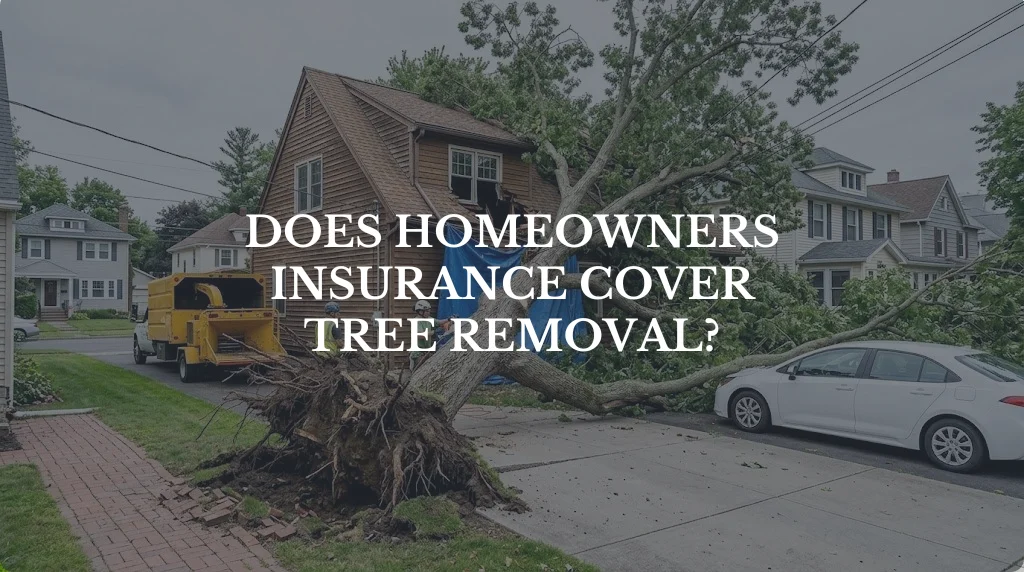
Standard policies in the Capital District are designed to protect your financial interest in your dwelling. If an oak tree crashes onto your roof during an Upstate New York ice storm, your policy will likely cover both the structural repairs and the cost to have a professional service haul the debris away.
However, if the tree falls in a back corner of your property and hits nothing but grass, insurance adjusters typically view this as “land maintenance” rather than a covered loss.
The “Peril” Requirement
For coverage to trigger, the tree must fall due to a “covered peril.” Common covered perils include:
- Windstorms and Hurricanes
- Lightening strikes
- Weight of ice and snow
- Vandalism
When Does Tree Removal Coverage Actually Apply?
Coverage applies only when a tree falls because of a covered peril and hits an insured structure on your property.
Covered perils in New York homeowners policies typically include windstorm, hail, lightning, weight of ice or snow, fire, explosion, riot, aircraft, and vehicles not owned by you. If a healthy maple from your backyard in Albany crashes onto your roof during a March ice storm, your insurer will likely pay for removal plus repairs, minus your deductible.
Neighbor’s trees follow the same rule. If a tree from your Schenectady neighbor’s yard lands on your Troy home during a storm, your own policy handles the damage and removal first; subrogation may later recover costs from the neighbor’s insurer if negligence is proven.
Exceptions are narrow: some policies extend limited coverage if the fallen tree blocks a handicapped-accessible ramp or driveway, but yard-only debris removal is almost never covered.
Get free estimate
When is Tree Removal NOT Covered by Insurance?
Insurance will not cover the removal of a standing tree, even if it is dead, diseased, or leaning dangerously toward your house.
Property owners have a legal “duty of care” to maintain their landscape. If you have a rotting pine tree in your yard, insurance companies expect you to remove it before it falls. Waiting for a storm to blow it over is considered “failure to maintain.”
If an adjuster determines the tree was visibly neglected, they may deny a claim even if it hits your house, which is why searching for how to get expert tree removal for hazardous pines is a critical first step.
The “Open Yard” Rule
If a tree falls in your yard but does not hit a house, shed, or fence, you are responsible for the cleanup costs. While some policies offer a small “debris removal” rider (often capped at $500), it rarely covers the full average tree removal cost, which can be significantly higher for large hardwoods.
How Much Does Insurance Pay for Tree Removal?
When coverage is triggered, most policies have a specific cap for debris removal, usually between $500 and $1,000 per tree.
It is a common misconception that insurance pays for the entire job. While they may pay $50,000 to fix your crushed roof, the portion of the claim dedicated to actually cutting up and hauling the tree away is often limited.
- The Structure Limit: Repairs to the house fall under “Dwelling Coverage” (Coverage A).
- The Debris Limit: Removing the tree itself falls under “Additional Coverages.”
For the large tree removal, the $500 limit might not cover the entire bill, leaving the homeowner to cover the balance.
Does Insurance Cover My Neighbor’s Tree Falling on My House?
Yes, your own homeowners insurance covers the damage if a neighbor’s tree falls on your property, regardless of who owns the tree.
In the eyes of insurance companies, a tree falling during a storm is an “Act of God.” You file the claim through your policy, pay your deductible, and your insurance handles the rest.
However, if you can prove your neighbor was negligent, perhaps you sent them a certified letter months ago warning them the tree was dead, your insurance company may attempt “subrogation.” This is the process where they sue the neighbor’s insurance to get your deductible back and recoup their losses.
Get free estimate
Emergency Fallen Tree Removal and Insurance
In an emergency, you are required to take immediate action to prevent further damage, which insurance typically covers under “Reasonable Repairs.”
If a tree is currently resting on your roof and rain is pouring into your living room, you don’t have to wait for an adjuster to arrive before calling for help. In fact, most policies require you to mitigate the damage.
This is when you should call for emergency fallen tree removal. A professional crew will come out, tarp the roof, and remove the sections of the tree that are compromising the structure.
Document Everything for Your Claim
- Take Photos: Take wide shots and close-ups of the tree, the damage, and the root system.
- Keep the Wood: Do not let the crew haul everything away until the adjuster says it’s okay (or at least keep high-quality photos of the rot if negligence is an issue).
- Save Receipts: Every penny spent on emergency stabilization is usually reimbursable.
Steps to Take After a Tree Falls on Your Albany Property
Direct answer: 1) Ensure safety, 2) call your insurance company, 3) document damage, 4) hire a certified local tree service, and 5) review your policy annually.
- Safety first: Stay clear of downed power lines and unstable trees.
- File the claim: Call your agent within 24 hours; most policies require prompt notice.
- Document: Take timestamped photos of the tree, damage, and surroundings.
- Get professional help: Only ISA-certified arborists and fully insured crews should handle emergency fallen tree removal in Albany NY. DIY attempts can void coverage and create liability.
- Prevent future issues: Schedule annual inspections. Tree Removal Albany NY offers free risk assessments for Capital Region homeowners.
Strategic Internal Planning: Stump Removal
While insurance might pay to get the tree off your house, they almost never pay for stump removal.
Stump removal is considered a cosmetic landscape improvement. Once the “hazard” is gone (the fallen trunk), the insurance company’s job is done. This is a great time to evaluate your landscape.
Many homeowners choose to bundle their insurance-covered removal with our professional stump removal service to ensure the yard is completely restored and ready for replanting or new sod.
Why Choose Tree Removal Albany NY for Insurance Jobs?
Working with a knowledgeable local contractor makes the claims process significantly smoother.
We understand the documentation requirements that local adjusters in the Capital District look for. We provide itemized invoices that clearly separate “debris removal” from “structural stabilization,” making it easier for you to get the maximum reimbursement from your policy.
Our team is fully insured, protecting you from any further liability during the dangerous process of clearing storm damage.
If you’ve suffered a loss or are worried about a leaning hazard, don’t wait for the next storm. Contact us today for a professional evaluation.
Learn about average cost for tree removal
Get free estimate


