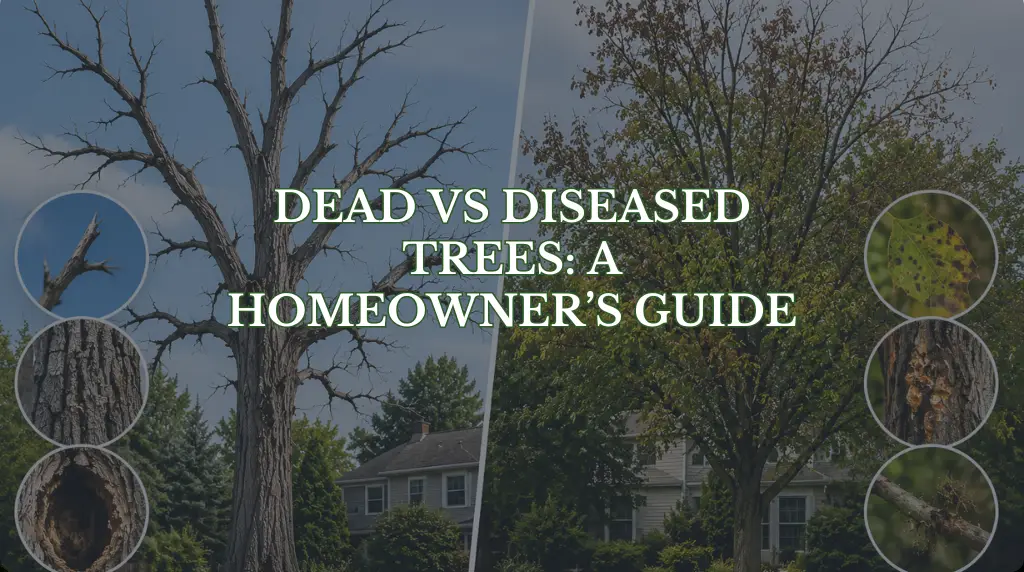
Dead vs Diseased Trees: A Homeowner’s Guide
Dead and diseased trees show different warning signs, risks, and treatment options. This guide explains how to identify tree decline, use the scratch test, recognize dangerous symptoms, and understand when treatment is possible versus when professional tree removal becomes the safest option.
Dead vs Diseased Trees: What Albany Property Owners Need to Know
A dead tree has no living tissue remaining — no green Cambium beneath the bark, no leaf or bud production, and no response to seasonal cues. A diseased tree is still alive but weakened by Pathogens, insect activity, root stress, or environmental damage, and it may still recover with early treatment.
The quickest way to determine the difference is the scratch test: gently peel back a small section of Bark using a fingernail or pocket knife. Green, moist tissue usually means the tree is alive. Brown, brittle, or dry tissue often means the tree is dead.
Understanding the difference matters because dead trees almost always become a safety hazard, while diseased trees can often be preserved if action is taken early. Many homeowners in Albany spend money removing trees that could have been treated, while others leave dead trees standing until falling limbs damage roofs, vehicles, fences, or power lines.
A professional inspection from Tree Removal Albany NY helps homeowners avoid both mistakes. Early diagnosis can reduce removal costs, prevent storm-related property damage, and protect nearby healthy trees from spreading disease.
What Is a Dead Tree?
A dead tree is a tree whose biological and cellular functions have permanently ceased. It no longer transports water through the Xylem, performs Photosynthesis, or produces new buds, leaves, or root growth through the Cambium. This is the core dead tree definition homeowners should understand when determining when a tree is dead.
Visible signs usually include dry or brittle branches, missing bark, severe Bark sloughing, hollow sections, and widespread Decay. As decomposition advances, the tree often becomes a Snag, meaning it remains standing but structurally unstable.
Dead trees create serious safety and liability concerns because brittle wood can fail unexpectedly during storms, wind, or heavy snow. Once a tree is confirmed dead, removal is not optional, only timing matters.
What Is a Diseased Tree?
A diseased tree is a living tree whose normal cellular function has been compromised by biological pathogens, insects, fungi, bacteria, or environmental stress. Unlike a dead tree, a diseased tree may still recover if the condition is identified early and matched with the correct treatment or intervention plan.
Common sick tree symptoms include leaf discoloration, canopy thinning, bark cracking, early leaf drop, fungal growth, and branch dieback.
In Albany, common tree disease identification issues include Anthracnose on Maple, Oak, and Sycamore, along with Dutch Elm Disease in American Elm. Other major threats include Oak Wilt in Red Oak and White Oak, Beech Leaf Disease in American Beech, Hemlock Woolly Adelgid in Eastern Hemlock, and Emerald Ash Borer attacking White Ash, Green Ash, and Black Ash.
Disease is a diagnosis, not a death sentence, but delayed treatment often turns a recoverable tree into a hazardous removal situation.
7 Warning Signs Your Tree May Be Dead or Diseased
The fastest way to identify signs of a dead tree vs diseased tree is to compare visible symptoms side-by-side.
Dead tree signs usually indicate complete structural and cellular failure, while dying tree signs and sick tree symptoms often suggest the tree is still alive but under stress. Use the checklist below to diagnose and confirm what stage your tree may be in.
1. Bark Condition
A dead tree often shows severe Bark sloughing, where bark falls off in large sheets and exposes dry, smooth wood underneath. The exposed surface usually appears brittle, gray, and lifeless with no healing around the edges.
A diseased tree typically keeps most bark attached, even when damaged. You may notice vertical splits, dark wet streaks, sunken wounds, or Cankers. Small Fungal conks may appear, but bark still shows signs of living attachment.
2. Leaf Behavior by Season
Leaf behavior is one of the clearest indicators homeowners notice first. A dead deciduous tree in Albany will remain bare during the growing season. If a maple, oak, or elm has no leaves by mid-summer, the tree is most likely dead.
A diseased tree usually still produces leaves, but symptoms appear abnormal. Common sick tree symptoms include yellowing, brown spotting, curled edges, undersized leaves, thinning canopy sections, or premature leaf drop affecting only certain branches.
3. Branch Flexibility (Snap Test)
The Snap test helps identify whether tissue inside the branch is still alive. On a dead tree, small twigs snap immediately with a sharp dry crack and reveal brown, brittle interiors.
A diseased tree behaves differently. Branches usually bend slightly before breaking and often expose green or moist tissue inside, showing that some water movement and cellular activity still remain.
4. Cambium Color (Scratch Test)
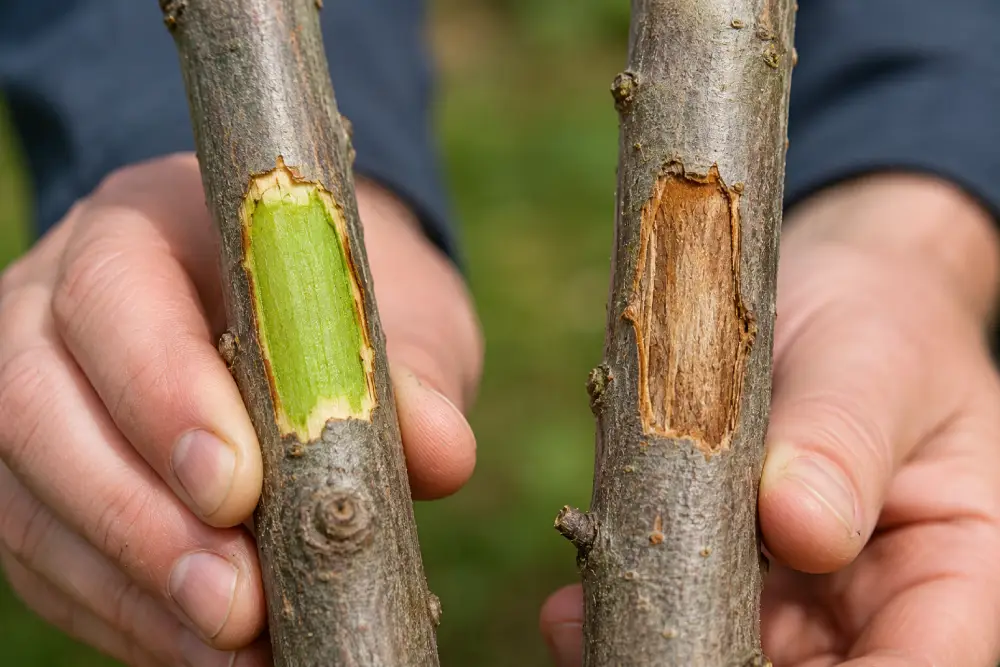
The Cambium scratch test is one of the most reliable ways to identify a dead tree. Scratching beneath the bark of a dead tree reveals brown, gray, or dry tissue with no moisture.
A diseased tree still shows green cambium beneath the bark, although the layer may appear pale, thin, or uneven due to stress and disease progression.
5. Fungal Growth
Heavy fungal growth usually signals advanced decay. A dead tree commonly develops large mushrooms, trunk rot, or extensive shelf fungi along major limbs and trunk sections, indicating structural breakdown is already established.
A diseased tree may show isolated fungal spots or minor cankers, but widespread colonization has not fully taken over yet.
6. Root Zone Condition
Dead trees often show root failure symptoms around the base. Soil may begin lifting, roots appear dry or exposed, and mushroom rings from Armillaria may develop near the trunk.
A diseased tree usually maintains an intact root collar, though slight oozing, discoloration, or minor soil movement can still appear.
7. Pest Activity
Heavy insect activity strongly suggests a tree is dead or nearing structural failure. Signs include borer Exit holes, piles of Sawdust frass, and visible Woodpecker damage. Woodpeckers are often attracted to dead trees because insect colonies are already established inside.
A diseased tree may still show pest pressure, but the infestation has not yet caused severe structural damage.
If four or more of these signs match the “dead tree” category, the tree is likely beyond recovery and should be professionally assessed for removal before failure occurs. Homeowners who are unsure what they are seeing can schedule a free inspection with Tree Removal Albany NY to confirm whether the tree can still be treated or safely needs removal.
The Scratch Test — How Homeowners Can Check at Home
The tree scratch test is one of the fastest ways to check if a tree is alive or dead. This simple diagnostic method helps homeowners examine living tissue beneath the bark and usually takes less than 30 seconds.
- Choose a small Twig or Branch, ideally pencil-thick.
- Use your fingernail or a pocketknife to lightly scratch away a thin section of Bark.
- Examine the freshly exposed Cambium underneath.
- Green or pale green tissue means the branch is still alive and the tree may be diseased rather than dead.
- Brown, gray, or completely dry tissue usually means that section is dead.
- Repeat the test on multiple branches at different heights throughout the Canopy.
The important limitation is that the scratch test only evaluates individual branches, not the entire tree.
A tree may still have living lower limbs while the upper canopy and Root collar are failing. Whole-tree assessment requires professional evaluation to accurately determine structural safety and whether removal is necessary.
Why DIY Diagnosis Misses What Matters Most
Basic symptoms can help homeowners identify possible tree problems, but knowing when to call an arborist is critical because the most dangerous issues are often invisible from the outside. A professional tree assessment in Albany evaluates structural stability, disease progression, and failure risk far beyond what visual inspection alone can reveal.
Internal Decay You Can’t See
Certified arborists use Resistograph testing to detect hidden cavities and internal decay. Many hazardous trees still appear healthy externally while the trunk is structurally hollow inside.
Root System Health
Air-spade excavation allows arborists to inspect root systems without damaging them. This process reveals root rot, girdling roots, buried root collars, and underground structural problems invisible above the soil line.
Pathogen Identification
Many diseases produce similar symptoms, making visual diagnosis unreliable. Professional Laboratory testing may be required to confirm pathogens and determine the correct treatment approach.
Risk Assessment (TRAQ)
Tree Risk Assessment Qualification, commonly called TRAQ, helps certified arborists evaluate the probability of tree failure and identify nearby targets such as homes, driveways, vehicles, sidewalks, and utility lines.
A diseased tree near a structure or power line carries significantly greater risk than the same tree in an open area, especially during storms or high winds.
In high-risk situations where structural failure appears imminent, emergency tree removal may be necessary to prevent sudden property damage or injury.
Treatment vs. Removal Decision
Even treatable trees may not always justify the cost of long-term intervention. Professional judgment considers species, age, structural integrity, location, recovery potential, and removal risk before recommending treatment or removal.
The biggest risk of DIY diagnosis is getting the decision wrong. A misidentified dead tree can fail suddenly and damage valuable property, while a treatable tree may be removed unnecessarily. In most cases, a certified arborist evaluation from Tree Removal Albany NY saves homeowners money by preventing both outcomes.
What to Do With a Dead Tree
A confirmed dead tree should be removed as soon as reasonably possible. The real question is not whether removal is necessary, but when to remove it and who should handle the work safely. Dead tree removal in Albany becomes more dangerous and expensive the longer structural decay continues.
Under New York liability law, property owners may be held responsible if a known hazardous tree damages neighboring property, vehicles, utility lines, or injures someone.
Most dead trees begin experiencing structural failure within 1 to 5 years, though weakened limbs can fall much sooner during storms or high winds. Dead wood also attracts pests like Carpenter ants, Termites, and wood-boring beetles that accelerate internal deterioration.
Professional tree removal typically starts with an on-site inspection from an ISA Certified Arborist, followed by a written estimate outlining removal scope, safety concerns, and cost.
Depending on the tree’s size and location, removal may involve Sectional dismantling, a Spider Lift, or crane-assisted removal for hazardous situations. Many homeowners also choose stump grinding to fully remove the remaining base and root flare.
What to Do With a Diseased Tree
A diseased tree often can be saved, but the available treatment options narrow quickly as disease progression advances. Early intervention preserves choices, while delayed action frequently turns a manageable condition into a removal situation. Diseased tree treatment in Albany depends on accurate diagnosis, tree species, structural condition, and how far the disease has spread.
1. Targeted Treatment
Professional Pesticide injection, Fungicide applications, and Systemic treatment can slow or stop diseases like Emerald Ash Borer, Dutch Elm Disease, and some fungal infections when identified early.
2. Selective Pruning
Removing infected limbs may preserve the remaining healthy structure. Techniques like Crown reduction and Deadwooding can improve safety and extend the tree’s lifespan for years.
3. Soil & Root Management
Some sick tree symptoms are caused by environmental stress rather than pathogens. Treatments such as Vertical mulching, Root pruning, and Aeration help stressed root systems recover.
4. Monitoring with Scheduled Reassessment
Slow-progressing diseases may only require annual or semi-annual monitoring. Regular inspections document disease progression and allow homeowners to act before structural failure develops.
If disease has spread beyond 50% of the canopy or reached the main trunk, removal often becomes the safest and most cost-effective option. A certified assessment from Tree Removal Albany NY determines whether the tree can realistically recover or should be removed before risks increase.
Common Trees in Albany That Often Get Misdiagnosed
Tree disease identification in Albany is difficult because many declining trees appear healthy until internal damage becomes severe. Some species hide symptoms for years, while others decline extremely fast once visible signs appear.
Ash Trees (Green, White, Black)
Green Ash, White Ash, and Black Ash commonly suffer from Emerald Ash Borer. Early infestations attack the cambium internally, so ash trees may still appear alive while the upper canopy is already dying and structurally unsafe—making professional dead ash tree cutting in Capital Region NY essential before the damage compromises your entire property.
Norway Maple
Norway Maple frequently develops Verticillium Wilt. Many homeowners mistake one-sided canopy dieback as isolated damage, but the disease spreads through the vascular system and often affects the entire tree.
Eastern Hemlock
Eastern Hemlock infested with Hemlock Woolly Adelgid may appear drought-stressed for years before rapid decline begins. Needle thinning and branch loss are often overlooked until recovery is unlikely.
American Elm
American Elm infected by Dutch Elm Disease can initially resemble ordinary leaf scorch. Early-season diagnosis is critical because treatment options narrow quickly after vascular spread begins.
Oak (Red and White)
Red Oak and White Oak respond very differently to Oak Wilt. Red oaks may die within weeks, while white oaks decline more slowly, creating very different removal timelines and urgency levels.
Beech
American Beech affected by Beech Leaf Disease often deteriorate faster than homeowners expect. Trees that looked healthy last year may now show major canopy thinning and irreversible decline.
How Much Does Tree Removal vs Treatment Cost?
Tree removal vs treatment cost in Albany depends on the tree’s condition, size, location, and how early the problem is identified. In many cases, early diseased tree treatment costs far less than delayed dead tree removal.
| Service | Typical Cost in Albany | When It Makes Sense |
| Free on-site assessment | $0 | First step for any tree concern |
| Targeted disease treatment | $150 – $600 | Disease caught early with strong recovery potential |
| Selective pruning | $250 – $800 | Disease limited to specific limbs or canopy sections |
| Small dead tree removal (<25 ft) | $250 – $500 | Confirmed dead tree with easy access |
| Medium dead tree removal (25–50 ft) | $500 – $1,200 | Most residential removals |
| Large dead tree removal (50–75 ft) | $1,200 – $2,500 | Mature canopy trees near homes or driveways |
| Crane-assisted removal | +$500 – $2,000 | Hazardous trees over roofs, garages, or utilities |
| Stump grinding (add-on) | $100 – $400 | After tree removal to eliminate remaining stump |
Professional assessments help homeowners avoid paying for unnecessary removals while preventing expensive emergency situations later.
In many cases, a $300 treatment today prevents a $2,000 removal a few years later. On the other hand, delaying removal of a confirmed dead tree often increases risk, cleanup complexity, and final cost.
A free assessment helps determine which path makes the most financial and structural sense for your property.
Get a Free Tree Assessment in Albany, NY
Dead, diseased, and declining trees all require accurate diagnosis before the right decision can be made. Tree Removal Albany NY provides free on-site tree assessments throughout Albany and the Capital Region.
Our certified arborists evaluate your tree’s actual condition, recommend treatment or removal based on evidence, and provide a written estimate before any work begins.
Frequently Asked Questions
Can a dead tree come back to life?
No. Once the Cambium is dry throughout the tree and no living tissue remains, recovery is biologically impossible. Trees that leaf out again in spring were dormant, not dead. A professional inspection confirms the difference accurately.
How quickly does a diseased tree become a dead tree?
Disease progression depends on the pathogen and tree species. Oak Wilt may kill red oaks within weeks, while Dutch Elm Disease often progresses over multiple seasons. Early diagnosis determines how much time remains for treatment.
Is a tree with dead branches a dead tree?
Not always. Many living trees contain some deadwood after storms or environmental stress. Trees with less than 30% dead branches are often recoverable, while trees exceeding 50% canopy decline usually face serious structural issues requiring arborist evaluation.
Will my insurance cover removal of a dead tree?
Usually not. Homeowner insurance commonly covers removal only after a tree damages a covered structure. Preventive removal is typically the homeowner’s responsibility, but removing hazardous trees early reduces future liability risk under New York liability law.
Can I treat a diseased tree myself?
Basic treatments like Fungicide sprays may help minor issues, but incorrect treatment wastes money and delays proper intervention. Accurate disease identification should come first through a certified assessment.
How do I prevent disease in my other trees?
Prevention starts with regular inspections, proper pruning, soil management, and fast removal of confirmed infected trees. Sterilizing pruning tools also helps reduce disease spread between trees.
What if my neighbor’s dead tree threatens my property?
Under New York law, you may formally notify your neighbor of the hazard. Written documentation, photos, and professional hazard assessments strengthen liability protection if the tree later causes damage.
Do you offer free tree assessments in Albany?
Yes. Tree Removal Albany NY provides free on-site evaluations throughout the Capital Region. An ISA Certified Arborist can determine whether your tree is dead, diseased, or potentially recoverable and recommend the safest next step.


