Emerald Ash Borer in Albany NY: Signs, Treatment & Removal Timeline
Emerald Ash Borer (Agrilus planipennis) is an invasive beetle that kills all native Ash species in Albany NY by destroying the tree’s vascular cambium layer. Infested Ash trees typically die within 2–4 years and become structural hazards requiring removal.
What Is the Emerald Ash Borer (EAB)?
Emerald Ash Borer is a wood-boring beetle native to northeastern Asia that has killed more than 50 million ash trees across North America since its confirmed U.S. discovery in Michigan in 2002, according to USDA APHIS (updated 2023).
The beetle (Agrilus planipennis) belongs to the family Buprestidae, metallic wood-boring beetles whose larvae feed beneath bark and sever the phloem and cambium tissues that move water and nutrients through a tree.
Adult EAB beetles are roughly half an inch long, with a distinctive iridescent emerald-green exterior and a bright, coppery-red abdomen visible when wings are spread. Adults emerge in late May through July in Albany’s climate, leave the characteristic D-shaped exit holes in bark, and begin laying eggs in bark crevices.
Eggs hatch into cream-colored, segmented larvae that immediately begin tunneling through the cambium layer in serpentine, S-shaped galleries and galleries that, once extensive enough, girdle the tree and cause death.
The vascular destruction caused by larval feeding is irreversible once it exceeds approximately 30% canopy dieback, which is why early identification and treatment timelines determine whether an Albany ash tree can be saved or must be removed.
How EAB Arrived in the Capital District
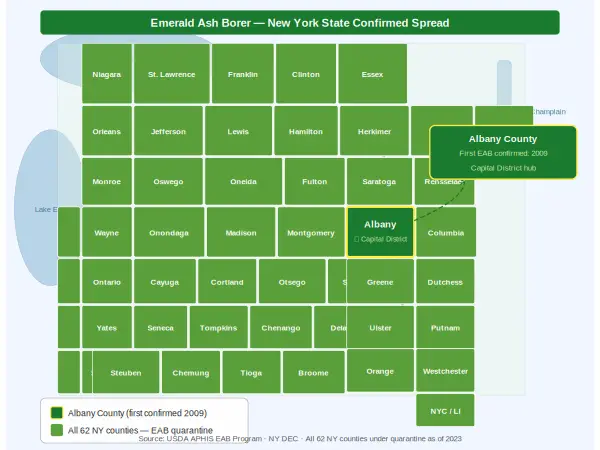
EAB arrived in New York State through the movement of infested firewood and nursery stock, the primary vectors identified by the New York State Department of Environmental Conservation (NY DEC).
Albany County received its first confirmed EAB detection in 2009, placing the Capital District among the earliest affected counties in New York.
The Capital District’s position as a regional hub, with Interstate 87, Interstate 90, and the Adirondack Northway all converging near Albany, made firewood movement a particularly high-risk pathway. Campers, hikers, and seasonal residents moving cut wood from infested areas spread EAB larvae embedded in bark before quarantine protocols were firmly established.
As of the NY DEC’s most recent quarantine order, all 62 New York State counties are subject to EAB firewood movement restrictions. Albany County homeowners, contractors, and landscapers are legally required to comply with disposal and transport rules, rules covered in detail in the Albany-Specific EAB Disposal section below.
Albany Ash Species at Risk
Albany’s urban forest and residential properties host two ash species particularly vulnerable to EAB: White Ash and Green Ash. Both are classified as confirmed EAB hosts by USDA APHIS, and both lack any natural resistance to Agrilus planipennis infestation.
White Ash (Fraxinus americana)
White Ash is one of the most commonly planted shade trees on Albany residential lots and along Capital District neighborhood streets, prized for its fast growth rate, fall color, and tolerance of compacted urban soils.
White Ash trees in Albany are identified by their compound leaves with 5–9 leaflets, diamond-pattern bark on mature specimens, and opposite branching structure.
Emerald Ash Borer (EAB) infests White Ash trees aggressively. The relatively smooth bark of young White Ash trees makes it easy for adult beetles to lay their eggs.
When large-diameter White Ash trees die from an infestation, they are especially likely to become structural hazards. This is due to their tall canopy and substantial trunk mass.
Green Ash (Fraxinus pennsylvanica)
Green Ash is the most widely planted street tree species across Albany’s older neighborhoods, including Pine Hills, Center Square, and the Hudson/Park Historic District, because municipal foresters favored it for its hardiness and tolerance of wet soils along curb lines.
Green Ash is identified by its 7–9 leaflet compound leaves, serrated leaflet margins, and characteristic samara (winged seed) clusters.
Green Ash succumbs to EAB at the same rate as White Ash. All native Fraxinus species are confirmed hosts.
Green Ash is highly prevalent in Albany’s street tree inventory. Consequently, a large proportion of public and private trees along Albany boulevards and residential streets are at active EAB risk.
Not sure if your tree is an ash? Our ISA Certified Arborist identifies ash species at no charge during your free EAB hazard assessment.
6 Signs of EAB Infestation on Albany Ash Trees
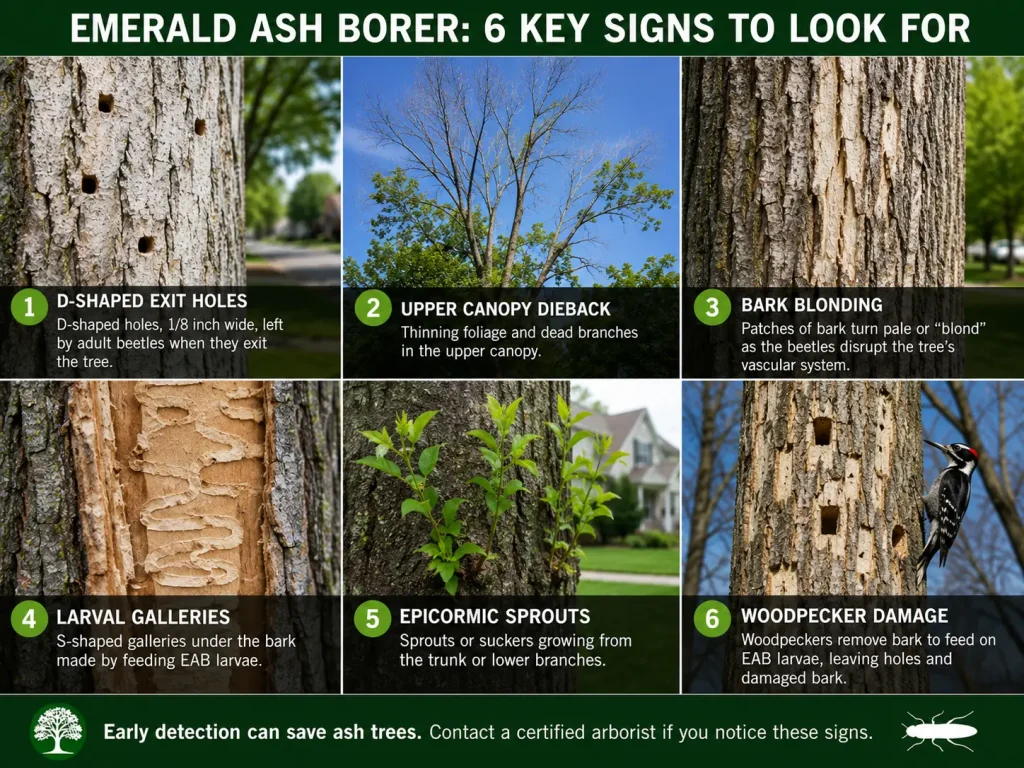
Albany ash trees show six identifiable signs of EAB infestation, progressing in severity from early-stage exit holes to late-stage structural collapse.
Recognizing these signs in the earliest stages before canopy dieback reaches 30% is the threshold that separates treatable trees from trees that require removal.
Below are the six confirmed EAB infestation signs to inspect on Albany ash trees:
1. D-Shaped Exit Holes
D-shaped exit holes in ash bark are the single most definitive visual sign of active EAB infestation on Albany trees.
Adult beetles emerge through the outer bark by chewing a precisely D-shaped hole measuring approximately 1/8 inch (3–4 mm) across a shape created by the beetle’s flat dorsal surface pressing against the bark during emergence.
These holes appear on the trunk, main scaffold branches, and occasionally large lateral limbs of infested Albany ash trees. The flat edge of the D is always oriented horizontally. Homeowners frequently mistake EAB exit holes for holes made by woodpeckers or other wood-borers, but the sharp, clean, flat-edged D-shape is unique to Agrilus planipennis.
If you find even a single D-shaped hole on your Albany ash tree, contact an ISA Certified Arborist for assessment immediately a single hole indicates adult EAB have been present for at least one full season.
2. Canopy Dieback from the Top Down
Canopy dieback beginning at the crown tips and progressing downward through successive branch layers is the most visible whole-tree sign of EAB infestation in Albany.
EAB larval galleries sever the phloem layer that delivers sugars downward from leaves to roots and because the uppermost branches depend most heavily on long-distance phloem transport, they are the first to starve and die.
Early-stage dieback shows as thinning and browning in the topmost 25–30% of the canopy during the growing season. Mid-stage dieback progresses to the mid-canopy within one to two additional seasons.
Albany homeowners often misidentify early canopy dieback as drought stress or normal seasonal thinning, delaying the intervention window when emamectin benzoate treatment is still viable.
3. Bark Splitting and Blonding
Bark splitting accompanied by “blonding” areas of pale, bleached, or yellowed outer bark indicates active larval galleries directly beneath the bark surface on Albany ash trees.
As EAB larvae feed through the cambium layer, the tissue beneath the bark dies and desiccates, causing the outer bark to crack, loosen, and separate from the wood.
The exposed sapwood beneath bark splits frequently shows vertical cracks packed with frass a fine, sawdust-like mixture of larval excrement and chewed wood fiber.
Bark blonding is most visible on the middle and lower trunk sections of infested Albany trees, particularly after a section of bark falls away to reveal the pale, damaged wood beneath.
4. S-Shaped Larval Galleries
S-shaped larval galleries beneath the bark surface are the direct anatomical evidence of EAB larval feeding on Albany ash trees.
Peeling a section of loose or split bark from a suspected tree reveals characteristic serpentine, winding tunnels packed tightly with frass.
These galleries follow the cambium layer the critical vascular tissue layer and effectively girdle the tree when galleries from multiple larvae overlap and sever the entire circumference of the trunk or branch.
A single heavily infested Albany ash tree can harbor hundreds of larvae across multiple seasons of gallery development.
The gallery pattern is distinctive enough that certified arborists can confirm EAB infestation from gallery morphology alone, even when exit holes or canopy symptoms are ambiguous.
5. Epicormic Sprouting at Trunk Base
Epicormic sprouting the emergence of dense clusters of small shoots from the trunk base and root crown of an ash tree is a stress response signal that indicates the tree’s crown is receiving insufficient nutrient transport from its root system.
In Albany ash trees infested with EAB, epicormic sprouts at the base and lower trunk represent the tree’s attempt to create new photosynthetic tissue closer to the root zone, compensating for the loss of canopy function caused by larval girdling in the upper cambium.
Epicormic sprouting alone does not confirm EAB, as other stressors can trigger the same response, but epicormic sprouts combined with any of the above signs constitute a strong presumptive EAB infestation requiring immediate professional evaluation.
6. Increased Woodpecker Activity
Concentrated woodpecker foraging activity on a specific ash tree particularly in winter and early spring when Albany woodpeckers are most active signals the presence of EAB larvae beneath the bark.
Pileated Woodpeckers, Downy Woodpeckers, and Hairy Woodpeckers all target EAB larvae as a food source, excavating irregular, flaking sections of bark from the trunk and scaffold limbs.
Woodpecker damage from EAB foraging appears as large, irregular patches of stripped or excavated bark quite distinct from the clean, circular holes woodpeckers drill for nesting. The NY DEC confirms that “blonding” from woodpecker foraging on EAB larvae is one of the most reliable remote visual indicators of EAB infestation in New York State urban forests.
EAB Timeline: From Infestation to Tree Death
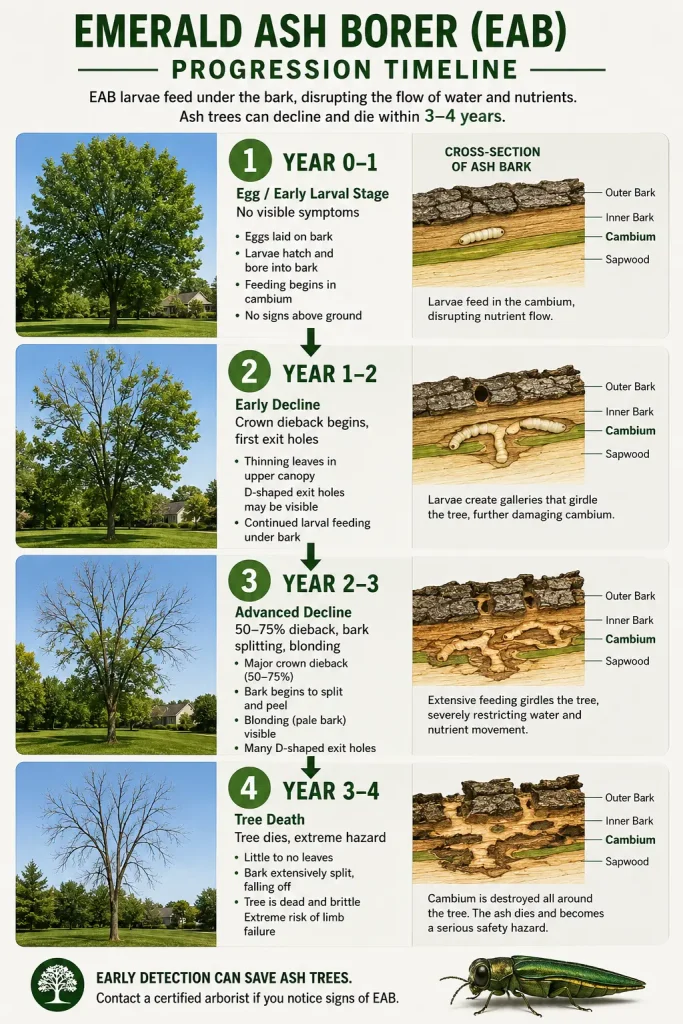
EAB-infested Albany ash trees follow a predictable four-stage decline timeline that typically spans 2–4 years from initial infestation to complete tree death.
| Stage | Timeframe | Observable Signs | Tree Status |
| Stage 1 — Early Infestation | Year 0–1 | No visible symptoms. Larvae actively feeding in cambium. | Treatable |
| Stage 2 — Active Decline | Year 1–2 | D-shaped exit holes appear. Top 25–30% canopy dieback begins. | Treatable (emamectin benzoate viable) |
| Stage 3 — Advanced Decline | Year 2–3 | 50–75% canopy dieback. Bark splitting, blonding, epicormic sprouts, heavy woodpecker damage. | Removal Recommended |
| Stage 4 — Tree Death | Year 3–4 | Complete canopy death. Structural failure risk. Brittle wood. | Emergency Removal Required |
The most dangerous misconception Albany property owners hold about EAB is that a visually healthy-looking ash tree is safe.
According to USDA APHIS research, EAB larvae can feed inside a tree for an entire season before showing any exterior symptoms.
Consequently, preventive treatment or professional inspection is the only reliable early detection method. This is especially true for Albany ash trees in neighborhoods where EAB is already confirmed.
Dead ash trees deteriorate rapidly. Within 12–18 months of death, the wood becomes brittle and unpredictable, increasing the difficulty and risk of removal and elevating the cost of removal significantly compared to removal of a standing tree in decline.
A fully dead Stage 4 ash tree with overhead utility exposure or proximity to a structure qualifies as an emergency tree removal situation where same-day or next-day response is required to prevent property damage. Proactive assessment protects both your property and your removal budget.
Can an EAB-Infested Ash Tree Be Saved?
Yes an EAB-infested ash tree in Albany can be saved if the infestation is treated before canopy dieback reaches 30%, using emamectin benzoate trunk injection administered by a licensed pesticide applicator.
Trees with greater than 30% canopy dieback have sustained vascular damage too extensive for treatment to restore canopy function, and removal is the appropriate recommendation.
Emamectin Benzoate (TREE-äge) Trunk Injection
Emamectin benzoate is the most effective systemic insecticide treatment for EAB-infested ash trees. It is sold under the trade name TREE-äge by Arborjet. The treatment is applied by direct injection into the tree’s xylem tissue through small-diameter ports drilled at the base of the trunk.
This active ingredient translocates through the water-conducting tissue upward into the crown. Feeding EAB larvae and adult beetles then ingest it, which causes larval mortality within weeks.
According to the 2022 USDA Forest Service treatment guidelines, emamectin benzoate treatments provide 2-year protection per application cycle.
A single treatment cycle for a medium-sized Albany residential ash tree (12–18 inch DBH) typically costs $150–$350, depending on trunk diameter.
This treatment must be applied by a licensed commercial pesticide applicator in New York State. Homeowner application of TREE-äge is not legally permitted.
When Treatment Is Effective (Under 30% Canopy Loss)
Treatment with emamectin benzoate is effective when Albany ash trees retain more than 70% of their healthy canopy meaning dieback is limited to the uppermost branch tips and has not progressed into the mid-canopy or main scaffold branches.
At this stage, the cambium layer below the dieback zone is still sufficiently intact to translocate the systemic treatment throughout the tree, and the root system retains enough stored energy to support recovery.
Trees treated at Stage 1 or early Stage 2 regularly recover full canopy density within 2–3 growing seasons following emamectin benzoate injection, provided treatment is repeated on the 2-year cycle.
Preventive treatment of high-value ash trees before any EAB infestation signs appear is also a valid strategy endorsed by the International Society of Arboriculture (ISA) for ash trees in EAB-confirmed areas like Albany County.
When Removal Is the Only Option
Removal is the only appropriate option when an Albany ash tree shows more than 30% canopy dieback, extensive bark splitting across the trunk, or has entered Stage 3 or Stage 4 decline as defined in the EAB timeline table above.
At this stage, the cambium damage is too extensive for systemic treatment to restore vascular function even if larvae are killed, the tree cannot regenerate the destroyed vascular tissue or recover adequate canopy density to photosynthesize at a functional level.
Dead and declining EAB-infested ash trees in Albany also present an escalating liability risk: ash wood becomes brittle and structurally unpredictable within 12–18 months of death, and falling limbs or full stem failure can cause property damage or personal injury.
When an ash tree reaches this stage, prompt EAB tree removal in Albany is the safest path to protect your property and eliminate the liability before structural failure occurs. Albany property owners carrying homeowners insurance should be aware that delays in removing documented hazard trees can affect claims.
Our ISA Certified Arborist provides written hazard assessment documentation for insurance purposes at no additional charge.
Cost of EAB Treatment vs. Ash Tree Removal in Albany

The 5-year cost comparison between EAB treatment and ash tree removal in Albany depends primarily on the tree’s current health stage and trunk diameter (DBH). Below is a realistic cost projection for a typical residential ash tree in Albany at 14-inch DBH:
| Cost Factor | EAB Treatment Path (Stage 1–2 Tree) | Removal Path (Stage 3–4 Tree) |
| Year 1 ISA Assessment | $0 (free with us) | $0 (free with us) |
| Year 1 Treatment (emamectin benzoate) | $200–$280 | — |
| Year 1 Removal Cost | — | $900–$1,800 |
| Year 2 Monitoring Visit | $75–$125 | — |
| Year 3 Re-treatment | $200–$280 | — |
| Year 3 Stump Grinding | — | $150–$300 |
| Year 4 Monitoring | $75–$125 | — |
| Year 5 Re-treatment | $200–$280 | — |
| Year 5 Replacement Tree Planting | — | $300–$600 |
| 5-Year Total (estimated) | $750–$1,090 | $1,350–$2,700 |
| Tree retained? | ✅ Yes — full canopy | ❌ No — replaced |
Key cost variable: A dead or Stage 4 ash tree in Albany costs significantly more to remove than a living Stage 2 tree — often 40–60% more — due to the additional rigging, sectional dismantling, and equipment required to safely remove brittle, structurally compromised wood near structures.
Removal costs in the table above assume a living or recently dead tree. Removal of a fully dead, multi-year-standing ash in a confined Albany backyard with overhead utilities can exceed $3,000–$4,500 for larger specimens.
Stump grinding after removal adds $150–$300 for a typical ash stump and is recommended to eliminate the remaining root mass and allow site replanting.
Bottom line: If your Albany ash tree is at Stage 1 or Stage 2, treatment is the economically superior option by a significant margin and preserves a mature tree that would cost $2,000–$8,000 to replace at equivalent size. If your tree has already reached Stage 3 or Stage 4, prompt removal protects property and reduces removal cost before the wood deteriorates further.
Get an exact quote for your Albany ash tree. Our ISA Certified Arborist provides a written assessment and treatment or removal cost estimate at no charge.
Albany-Specific Rules for EAB Ash Tree Disposal (NY DEC Firewood Quarantine)
Albany County ash wood disposal is governed by the New York State DEC EAB quarantine order, which prohibits the movement of ash wood, ash nursery stock, and hardwood firewood (regardless of species) out of regulated areas without a compliance agreement or valid compliance certificate from the NY DEC Division of Lands and Forests.
The key disposal rules Albany property owners must understand following ash tree removal:
- Ash wood cannot be transported out of Albany County as logs, rounds, or chunks without NY DEC documentation. This applies to homeowners, landscapers, and tree service contractors equally.
- Ash firewood cannot be moved more than 50 miles from its origin point, and only within New York State, under the NY DEC’s current hardwood firewood rule, a restriction that exists because EAB larvae can survive for months inside cut wood and infest new areas upon transport.
- Chips from ash trees are exempt from the transport restriction, provided the chips are less than 1 inch in any dimension. This is why professional tree services chip ash wood on-site rather than hauling logs.
- Burning ash wood on-site (where local fire ordinances permit) is the simplest compliant disposal method for Albany homeowners with small quantities of ash wood.
- Ash stumps in the ground are not regulated, EAB larvae do not survive in in-ground stumps beyond one season, as the root system dries and becomes non-viable host material.
Our removal crews are fully trained in NY DEC EAB ash disposal compliance. All ash wood removed from Albany properties is chipped on-site or transported to a NY DEC-compliant disposal facility, we provide documentation of compliant disposal upon request, which some Albany property owners require for permit or HOA purposes.
For the current NY DEC quarantine map and full regulatory text, visit: dec.ny.gov/animals/7253.html (NY DEC Emerald Ash Borer page).
Best Replacement Trees for Albany After Ash Removal
Albany property owners replacing EAB-killed ash trees have strong native and proven ornamental options that provide comparable shade canopy, fall color, and structural form without EAB susceptibility.
The following replacement species perform well in Albany’s USDA Hardiness Zone 5b–6a climate and Capital District soil conditions:
1. Native Disease-Resistant Elm (Ulmus ‘Princeton’, ‘Valley Forge’)
ISA-recommended Dutch Elm Disease-resistant cultivars that replicate ash-sized shade canopy, tolerate Albany’s urban soils and road salt exposure, and provide excellent fall color. Growth rate is comparable to ash.
2. Bur Oak (Quercus macrocarpa)
Albany’s best long-term ash replacement for large-lot properties, with exceptional drought tolerance, USDA-confirmed resistance to all major pests and diseases, and a multi-century lifespan. Slower initial growth than ash, but structurally superior at maturity.
3. Swamp White Oak (Quercus bicolor)
A Capital District native tolerant of Albany’s periodic wet soil conditions, with attractive exfoliating bark and strong asymmetric branching structure. Excellent for Albany properties with drainage variability.
4. Tuliptree (Liriodendron tulipifera)
Fast-growing, straight-trunked native with distinctive tulip-shaped flowers and brilliant yellow fall color. Performs well in Albany’s climate and reaches canopy scale comparable to a mature ash within 15–20 years.
5. Hackberry (Celtis occidentalis)
Albany urban foresters’ quiet favorite: tolerates compacted soils, road salt, heat, and drought equally well, with minimal pest and disease pressure. An excellent street tree replacement in Albany neighborhoods where soil conditions are poor.
6. London Planetree (Platanus × acerifolia ‘Bloodgood’)
Proven urban performer for Albany’s toughest street-tree sites, with attractive mottled bark and large canopy spread. Anthracnose-resistant cultivars (‘Bloodgood’, ‘Liberty’) are recommended for Albany’s wet spring conditions.
Our arborist team plants replacement trees following ISA BMP planting standards proper root flare depth, no volcano mulching, and the correct species-site matching for Albany’s soil types.
Replacement planting is available as a combined service with ash removal for streamlined project completion and cost efficiency.
Frequently Asked Questions
How do I know if my Albany tree has EAB or a different pest?
The most definitive EAB confirmation sign on an Albany ash tree is the presence of D-shaped exit holes flat on one side, roughly 1/8 inch wide combined with S-shaped larval galleries visible beneath peeled bark. EAB is also host-specific: it only attacks Fraxinus species.
If your tree is not an ash, it cannot have EAB. Other common look-alike problems include borer beetles with round exit holes (which are circular, not D-shaped), fungal cankers (which produce discolored bark without galleries), and ash anthracnose (which causes leaf spotting without bark symptoms). Our ISA Certified Arborist provides free on-site identification.
Is EAB treatment covered by homeowner’s insurance in Albany?
EAB treatment costs are generally not covered by standard Albany homeowner’s insurance policies, as most policies exclude pest-related tree damage as a maintenance issue rather than a covered hazard.
However, removal of a dead or hazardous EAB-killed ash tree that poses risk to an insured structure may qualify for partial coverage under dwelling or other-structures provisions of some policies and our ISA Certified Arborist can provide written hazard tree documentation that supports insurance claims. Contact your insurance carrier directly to confirm your specific policy terms.
How long does an EAB-treated ash tree live after treatment?
An Albany ash tree treated with emamectin benzoate at Stage 1 or early Stage 2 before 30% canopy dieback can be expected to live a normal lifespan with ongoing 2-year treatment cycles maintained, based on USDA Forest Service treatment efficacy data.
The treatment does not cure existing vascular damage but kills active larvae and prevents new infestation, allowing the tree to stabilize and recover canopy in subsequent growing seasons.
Trees with good structural form, adequate soil moisture, and no secondary stressors (construction damage, drought, soil compaction) respond best to treatment and maintain full function for many decades when the treatment protocol is maintained.
Can I treat my Albany ash tree myself with store-bought products?
Homeowners can legally apply imidacloprid-based soil drench products (sold as Bayer Tree & Shrub Protect) to ash trees without a pesticide license in New York State however, emamectin benzoate (TREE-äge), which is the most effective EAB treatment available, requires a NYS commercial pesticide applicator license and is not available for homeowner use.
Imidacloprid soil drenches have significantly lower efficacy against EAB compared to emamectin benzoate trunk injection, particularly on trees with trunk diameter over 10 inches, because uptake through the soil is inconsistent.
For Albany ash trees with confirmed EAB presence or infestation risk, professional trunk injection with emamectin benzoate is the ISA-recommended treatment standard.
What happens to the EAB larvae after my ash tree is removed?
EAB larvae in freshly cut Albany ash wood remain viable inside logs and rounds for several months following cutting, which is the core reason NY DEC regulates ash wood transport. Chipping removes the bark-cambium layer where larvae feed and renders the larvae non-viable.
Burning dry ash wood thoroughly kills any remaining larvae. Larvae cannot survive in ash stumps left in the ground beyond a single season, as the root tissue dries out and becomes unsuitable host material. Our crews chip all ash material on-site for compliant, complete elimination of any viable larvae in removed trees.
How quickly does an ash tree need to be removed after it dies from EAB?
A dead EAB-killed ash tree in Albany should be assessed for removal within the first growing season after death ideally within 12 months of confirmed mortality. After 12–18 months, ash wood begins significant structural deterioration: the wood becomes brittle and unpredictable in failure direction, bark detaches creating falling hazard, and the root plate begins to decay, increasing windthrow risk.
Trees dead for 2 or more seasons are classified as high-risk hazard trees by Albany standards and require emergency removal protocols which are more expensive, more complex, and carry higher operational risk than removal of a recently deceased tree. Early removal also controls on-site EAB population before adult emergence in the following May–July flight season.


